

Thursday, 10 July 2014
Die in Poetry, Or Live Forever

In an age when there seem to be more poets than poems, and more poetry books than readers, it is definitely more difficult for anyone to go to history as an outstanding poets than, say, in Keats’s time, not to mention Li Bai or even Su Dongpo’s. Be that as it may, there are always a lucky few who can win some handsome prizes and much high national or international acclaim from time to time, not necessarily because their poems are truly great, but because some poetry lords and influential academicians with certain idiosyncrasies happen to notice and hand-pick their products. In the meantime, numerous practitioners of the art engage themselves, actively or otherwise, in the writing of poetry, as if to hope to die, or live forever there.
As one of such practitioners – I refrain from calling myself a ‘Canadian poet’ as a gesture to protest against the oppression of notorious Canadian mediocrity, I have been dying a slow death ever since August of 2004, when I first tried to scribble some stanzas in a foreign language, whose alphabet I did not start to learn in China until I was 19 years of age. While I care little about whether I can actually live forever in poetry, I do care enormously about what kind of poetry I should and could write. In fact, I have taught myself (and my teenage son Allen Qing Yuan, who is a quite widely published writer of poetry in his own right) that great poetry is, first of all, avant-garde by nature, if not unanimously by definition. For me, one major criterion for ‘best’ poetry is, and should be, the formal or stylistic innovativeness it embodies. Without breakthrough of some kind in the form, a poem may prove lovely and effective to certain extent, but not really great. To meet this self-imposed criterion, I have been experimenting with various forms as well as the uses of the English language. The best example to illustrate this effort is what I call ‘Siamese stanzas,’ a link form which I have invented to allow for simultaneous multi-readings:
Siamese Stanzas: On the Highway
tender
shines the night
the moon looks
foul and foolish
when dreams
come too close
on the fairy road failure to turn right
we drive we must drive
our newly painted jalopy farther and farther
with changed tires straight ahead
no less slowly in the wrong direction
Apparently, one can read the piece as a whole in at least three different ways, each presenting a new poem. Other forms I have invented or experimented with include ‘mini epic’ in bagua or eight trigrams, ‘one-act play poem,’ ‘ideographic poem’ and ‘wuxing or 5-element poem,’ which are mostly developed from ancient or traditional Chinese folk forms and, hopefully, will turn out worthy experiments.
Another major criterion for great poetry is its accessibility. While being innovative or experimental is no excuse for anyone to write esoterically, a poem has to be readable if it aims to communicate something at all. As a poetry writer, I draw my inspirations mostly from reading, but alas, contemporary American, British or Canadian poetry often makes reading more of a pain than of a pleasure. On the one hand, I am undoubtedly too stupid to appreciate the beauty of most contemporary poems, especially those featured in high-sounding journals/anthologies or written by high-profiled poets. On the other, there are perhaps some good reasons why much-acclaimed ‘best’ poetry is nonsense even to poetry lovers like me. For one thing, the poet has nothing really meaningful to say in the first place; naturally, she has to say something like personalized codes or dreaming utterances. Second, the poet has something interesting to say, but wants to say it in such a mystifying way as to show that he is extraordinary in his use of language. Third, the all-powerful editor/judge/publisher chooses a nonsense-like poem either because of his personal taste or because of the poet’s reputation. No matter what, if a poet cannot use language in an accessible way, his or her work should be treated as diary rather than poetry.
A third major criterion for ‘best’ poetry may, as I see it, prove even more sociopolitical than the second one: in terms of traditional Chinese poetics, a fine poem ought to contain a ‘poetic eye,’ that is, something really fresh, witty, sensual, intriguing, soul-enriching or imagination-stimulating. As Badiou has strongly suggested, it would be imperative for the poet to say either something relatively new in a well-accepted way or something already existent in a relatively new way. Since the reader, targeted or not, plays an important role in this aspect, the poet becomes deeply involved in cultural politics with or without intention; indeed, the claim of no political stance or interest is itself a political manifesto. Whenever I write a piece, I feel compelled to give my work a poetic eye. For example, I have ambitiously woven the most ancient Chinese myths into a mini epic (titled ‘Chinese Chimes: The Ballad in Bagua’) for the first time in any language (to my best knowledge), not merely to reconstruct the earliest Chinese cultural history, but also to add something new to the English canon. Even when writing a mono-line, I would try to live up to such standards, although my work may often fail to do so.
Needless to say, there are always tensions between my audience, my compositional practices, and my imagination. While other practitioners may have different ways to navigate these tensions, I have a good pilot for myself: just as the king in The Alchemist advises Santiago to follow his heart, I follow my imagination. Although keenly aware that my poetic work does not have a ready appeal to most readers, I never go out of my usual way to cater to the taste of my targeted audience, not do I have a specifically intended audience in mind to begin with. For me, it is always more important and intriguing to write the best and worthiest kind of poetry I can than to find a particular group of readers. Unlike many other authors of Chinese origin who may purposefully try to write something nasty or negative about Chinese reality to appeal to the taste of certain western readers, and thus may become much more popular or better-recognized, I am not so concerned as they are about whether (contemporary) readers, editors or critics like what I have been writing, although I do believe my poetic work deserves notice.
In the most recent interview, I have mentioned that poetry seems to run in the blood of my family. My father had always wished to be a poet, though he never got anything published during his lifetime. Growing up in an impoverished Chinese village, I fell in love with poetry and dreamed about living like Li Bai at the age of 14 when I had my first exposure to poetry of any kind. Although I never got a single poem published before moving to Canada to pursue my graduate studies in English, I have been writing and publishing much more poetry than I myself imagined about eight years ago. Just before last Christmas, my poetry finally begun to appear in Chinese media, but ironically only after I became an internationally published practitioner of the art. More important, on the Remembrance Day of 2012, I and my younger son Allen Qing Yuan formed a ‘father-son camaraderie in poetry,’ as some editors like to call us, to publish our own literary e.zine called Poetry Pacific (poetrypacific.blogspot.ca), which has been growing much more robust than we anticipated, and which we plan to develop into a major platform to promote poetic/cultural exchange between English and Chinese in the near future.
For me, the meaning of life, if any at all, is to create a meaning for it – that is why and how I write what I do.
Changming Yuan, 4-time Pushcart nominee and author of Chansons of a Chinaman (Leaf Garden, 2009) and Landscaping (Flutter Press, 2013), grew up in rural China and published several monographs before moving to Canada. With a PhD in English, Yuan tutors privately in Vancouver, where he co-edits Poetry Pacific with Allen Qing Yuan (Poetry submissions welcome at editors.pp@gmail.com). Most recently interviewed by PANK, Yuan has poetry appear in Asia Literary Review, Best Canadian Poetry, BestNewPoemsOnline, LiNQ, London Magazine, Paris/Atlantic, Poetry Kanto, Salzburg Review, SAND, Taj Mahal Review, Threepenny Review, Two Thirds North and 700 other literary journals/anthologies across 27 countries.

Sunday, 20 April 2014

Wednesday, 19 March 2014
This is an interesting piece from the Disabilty Arts Online website.
http://www.disabilityartsonline.org.uk/beyond-watford?item=2093
Sunday, 10 February 2013
Exhuming Bukowski
From an early age I was attracted to poetry. Like most people my introduction to the art was through nursery rhymes and Edward Lear’s Limericks. At secondary school we were exposed to the Romantics, but also to Shakespeare, Dante, and even Kipling, a poet usually associated with the glories of the British Empire and one that who would not be considered appropriate in today’s schools (particularly those which have a high rate of children of Irish descent, as were the schools I attended).
Having left school, I continued to read poetry. T.S. Elliot was my first real passion but as time went on I began to discover a greater world. My interest in Beat poetry (particularly that of Ginsberg) led me to look at the wider world of American poetry. What struck me, as I got to learn more about the poetry of the USA, was the incredible diversity and invention from Walt Whitman and Emily Bishop to William Carlos Williams and John Berryman. It was during this time that I also happened upon the work of Charles Bukowski. It was like nothing I had ever come across in poetry. In fact I questioned whether it had any poetic value at all. The opening lines of a later poem of Bukowski summed up his work for me:
as the poems go into the thousands you realize that you've created very/ little.
‘As The Poems Go’]

In fact Bukowski was fairly prolific in his ‘poetic’ output. I had difficulty trying to understand his popularity amongst friends and serious poets. I, like many others, held Bukowski responsible for the deluge of bad poetry that seemed to be everywhere in the 70s onwards.1 It is only up until fairly recently that I have begun to re-evaluate my dismissive attitude towards this very influential poet and writer.
It was not through reviewing Bukowski’s poetry that led to my volte face, but through my understanding of the works of other, much earlier, poets. The great Roman poet Catullus [c. 84 B.C.-54 B.C.] was one of the earliest poets to react against the epic, that dominated the poetic narrative of ancient times right up to the Middle-ages. His poetry, occasionally, shows wild emotions the strength of his poetry, written in hendecasyllabic and elegiac couplets, illustrates a powerful and disciplined approach to the art.
Saturday, 12 May 2012
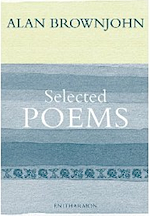
The Saner Places: Selected Poems
by Alan Brownjohn
by Alan Brownjohn
On Brownjohn Land.
A Fortnightly Review of
The Saner Places: Selected Poems
by Alan Brownjohn
£10.99 | Enitharmon Press | 60 pages
By Anthony Howell.
THE SEAL AROUND my freezer door has perished. I
ring Smeg, and learn that it is called a gasket, and will cost more than a new
fridge to replace. I feel that I am in Brownjohn Land.
 With so much of his focus on the small vicissitudes of
life rather than on its more grandiose themes, Alan Brownjohn might be the
Giorgio Morandi of contemporary poetry. I cannot help but associate Morandi,
and his humble arrangements of boxes and jars, with the Italian novelist Italo
Svevo. Born some twenty-five years before Morandi, and a friend of James Joyce,
Svevo was part of the modern initiative, yet wrote in a seemingly conservative
narrative style. His subjects, however, are notably devoid of heavy
significance. His Confessions of Zeno is written as the biography of a
man who wishes to put things straight for his analyst, to whom he has gone in an
attempt to give up smoking. The style is decidedly anti-’Beethovenic’ – and the
same could be said for much of the work of this very English poet. Like Morandi
in visual art, Brownjohn occupies an ambiguous position. Is he an ironic
modernist and a metaphysical force, or is he just a throw-back to Betjeman, as
Morandi was a return to figuration?
With so much of his focus on the small vicissitudes of
life rather than on its more grandiose themes, Alan Brownjohn might be the
Giorgio Morandi of contemporary poetry. I cannot help but associate Morandi,
and his humble arrangements of boxes and jars, with the Italian novelist Italo
Svevo. Born some twenty-five years before Morandi, and a friend of James Joyce,
Svevo was part of the modern initiative, yet wrote in a seemingly conservative
narrative style. His subjects, however, are notably devoid of heavy
significance. His Confessions of Zeno is written as the biography of a
man who wishes to put things straight for his analyst, to whom he has gone in an
attempt to give up smoking. The style is decidedly anti-’Beethovenic’ – and the
same could be said for much of the work of this very English poet. Like Morandi
in visual art, Brownjohn occupies an ambiguous position. Is he an ironic
modernist and a metaphysical force, or is he just a throw-back to Betjeman, as
Morandi was a return to figuration?
Certainly he shares certain Slough-like aspects
of the landscape with Betjeman. Eight-a–side railway compartments with no
corridor – such a gift to rapists! And the drab bombsites of the post-war
years providing the footprint for supermarkets. The poet teaches at
prep-schools, or attends office parties where squeakers unroll, but very often
there is a sense of the countryside out there in the dark, or in the background,
a heritage under siege – grumpily expressed in ‘Farmer’s Point of
View’.
I own certain acre-scraps of woodland,
scattered
On undulating ground; enough to lie hidden in. So,
On undulating ground; enough to lie hidden in. So,
About three times a year, and usually
August.
Pairs of people come to one or another patch. They stray
Pairs of people come to one or another patch. They stray
Around the edges first, plainly wanting some
excuse
To go on in; then talking, as if not concerned,
To go on in; then talking, as if not concerned,
And always of something else, not what they
intend.
They find their way, by one or another approach,
They find their way, by one or another approach,
To conducting sexual liaisons – on my land…
Friday, 20 January 2012
Carol Anne Duffy and the Poetic Equivalent of Ambulance Chasing
Background
I hold my hands up and freely admit that I have never had much time for Carol Anne Duffy’s work. I feel that her position as poet laureate reflects a devotion to making poetry ‘relevant’, leading to a debasement of the art of poetry itself.
From the outset what marked Duffy’s laureateship was not a commitment to the art of poetry but a flouting of her own liberal views (particularly playing to the gallery of The Guardian readership). In her first ‘poem’ as poet laureate, Duffy tackled the scandal over British MPs expenses. The fact that this was done in a poetic form: that of a sonnet; does not detract from the question of whether it works as a poem or is just simply a piece of populist doggerel. Most of Duffy’s writing, as laureate, deals with issues such as environmentalism, AIDS, the war in Afghanistan and even, embarrassingly enough, David Beckham. At times it seemed that the role of laureate came to resemble a schoolchild’s attempts to please his/her English teacher: what could be termed ‘fridge magnet poetry’ if you like.
Tuesday, 28 June 2011
Wednesday, 1 June 2011
Don't You Wonder Sometimes About Sound And Vision?*
Two forms of poetry that succinctly display some of the most important elements of poetry are the Limerick and the haiku.
 For many of us the first encounter with poetic s will be the Limerick and particularly those of Edward Lear. The Limerick is a five-line poem (sometimes the third and fourth line appear as one to make a quatrain) whose rhyme scheme is AABBA. The last word of the first line is also the last word of the final line.
The rhyme scheme (as well as the brevity of each poem) means that the Limerick is one that is easy to remember. But the rhyme scheme also creates a sense of the comical or the absurd and though Lear intended these works for children we should not overlook how he exploited the ‘music’ of poetry to great effect, which meant that the primary experience of the Limerick is not the ‘meaning, but the sound the poem makes. The playfulness of the language in the Limerick also helps to make it acceptable to the inexperience of childhood.
Wednesday, 4 May 2011
Style over Substance: errare humanum est, perseverare autem diabolicum
Essay by Phil Thornton
When do you think the following piece of literary criticism was written?
You ask why it is that at certain periods a corrupt literary style has come into being; and how it is that a gifted mind develops a leaning towards some fault or other (resulting in the prevalence at one period of a bombastic form of exposition, at another of an effeminate form, fashioned after the manner of songs); and why it is that at one time approval is won by extravagant conceits and at another by sentences of an abrupt, allusive character that convey more to the intelligence than to the ear; and why there have been era in which metaphors have been shamelessly exploited.
Friday, 22 April 2011
The Common Breath: a poetic tradition*
Essay by Tom Leonard
The politics of space on the page is a politics of democracy, of transference from world of text as “the” to that of reader-subject as “this”. It is the universalisation of the author-reader experience away from the world of passing-the-parcel to those fit to open the parcels of cultural referents of supposedly universal value (which opening of parcels has been the industry of literary-academic exegesis’s this past hundred years); towards the structuring of a system of common breath, integer of the universal human.
The basis of poetry is line, the basis of prose, paragraph—most of the time. Three types of basic poetry line: as unit of metre, as unit of meaning, as unit of articulation. The politics of space belongs to the last.
The politics of space on the page is a politics of democracy, of transference from world of text as “the” to that of reader-subject as “this”. It is the universalisation of the author-reader experience away from the world of passing-the-parcel to those fit to open the parcels of cultural referents of supposedly universal value (which opening of parcels has been the industry of literary-academic exegesis’s this past hundred years); towards the structuring of a system of common breath, integer of the universal human.
The basis of poetry is line, the basis of prose, paragraph—most of the time. Three types of basic poetry line: as unit of metre, as unit of meaning, as unit of articulation. The politics of space belongs to the last.
Monday, 4 April 2011
The War Poets: The Sound of distant drums
Essay by Denis Joe
Recently a Birkenhead (Wirral, UK) society opened a centre devoted to Wilfred Owen. I lived in Birkenhead for seven years and was always bemused by the fact that the town saw little merit in celebrating this most famous of poets. There is a stain glass window in the Museum and there is a small thoroughfare named after him, but that was all.
The new centre is modest in the extreme, it looks like just another shop and it is hard to imagine it as a ‘tourist spot’ as it has very little of interest in it.
Though I have little time for themes in poetry, preferring that the poem stands on its structure rather than on its literal meaning, with the War Poets it is nigh on impossible to mention them without , primarily, looking at the historical events in which they composed their poetical works[i]. Whilst personal experience may drive the poet in their work it is only as material; manipulated into a form for the audience to make sense of and even relate to their own lives. It is not the role of the poet to become an agitator for some cause or other and whilst Owen, Sassoon, Brookes, Graves, etc. called on their experience of fighting in World War 1, to inform their work it is laziness to see the work as comments on warfare.
Tuesday, 22 March 2011
Phantom of the Apple by John Kay

Review by Phil Thornton
This collection of American poet, John Kay’s work begins with a quote from Camus’ s ‘Myth of Sisyphus’;
“The worm is in man’s heart”
An apt start for a collection of poems pre-occupied with the author’s own heart related health issues. Like many American poets, Kay gets straight to the er, heart of the issue, forsaking the structural showboating and vainglorious stylizations of many European writers in a bid to connect via emotion. Not that Kay doesn’t have a style, but that style serves the poem and not the author.
Friday, 18 March 2011
Doing The Standing Still
Essay by Denis Joe
I remember going to a poetry reading at the Bluecoat, in Liverpool, a few years back. Gordon D Henry was reading and there was a Q&A session after. The first question asked from the audience left me gobsmacked at the arrogance of the questioner, who wanted to know how she could best use her poetry to put across her anti-racism.
I remember going to a poetry reading at the Bluecoat, in Liverpool, a few years back. Gordon D Henry was reading and there was a Q&A session after. The first question asked from the audience left me gobsmacked at the arrogance of the questioner, who wanted to know how she could best use her poetry to put across her anti-racism.
It was not simply her self-delusion of grandeur that rankled me but also that question implied that poetry was no better than journalism or propaganda. She seemed to suggest that there is nothing to poetry except the banality of its literal meaning.
Wednesday, 23 February 2011
Essay by Matthew Denvir

Though this poem is a typical example of a poet’s depiction of death (elegantly sorrowful and with a sense of loss), it doesn’t represent Yeats’ final word on the subject. His argument about death, about what it means to die, becomes more complex when his war poems are taken into account. And it is with these poems that the reader sees an attitude about death that is strikingly different from that represented by his other work. Simply put, in the universe created by Yeats’ poetry, death in war is a far different philosophical and existential experience than death by any other means.
The Poetics of Intolerance
Opinion Piece by Denis Joe
The news about the call to shut up US shock-jock, Glenn Beck, over the past month got me thinking about the ranters on this side of the Pond.
I recall it was one of the final Dead Good Poets Society open-mic nights at the Everyman, in Liverpool, before it closed, temporarily, for refurbishment.
Tuesday, 25 January 2011
Jim Morrison Was Not A Poet
Essay by Denis Joe
Take Away The Noise And There Is Little To Say
I recently attended a debate on the relevance of poetry today. Aside from the fact that poetry, like all art, moves with the times and thus is relevant, it was the way in which the speakers talked about what makes poetry relevant that made me feel uneasy.
It seems that poetry can never be justified on the basis of its craft. There always has to be some referral to other activities particularly song writing. It was the manner in which one of the speakers talked about Morrison, Dylan and even Morrissey as ‘poets’, and the way that there seemed to be an acceptance of this, as if it were a fact, that, initially, annoyed me, then got me thinking about why this is done. It seems that there is some embarrassment about poetry as a unique art form. The usual argument about the ‘relevance’ of poetry starts off by saying that the art is viewed as elitist and then goes on to say that ‘poetry is all around us’. Which rather sounds like an elitist statement: suggesting we are too stupid to see it.
The truth is poetry is not ‘all around us’. Advertisers, campaigners of some issue or other and even MP soundbites, may well utilise aspects of poetry, but few would see it as anything more than a jingle; a slogan or a vacuous statement. But none of these things can be called poetry, because they are created for a different function.
Like all other art forms, poetry has its own rules and tools that allow us to recognise it as something unique in itself. These rules alter over time because the material that is used to give poetry its form- language- is in constant flux. Also the manner in which that language is conveyed changes, creating new ways of expression. For example mobile-phone texting and Twittering, do away with, mainly, vowels. All this, and more, contribute to what Peter Levi described as The Noise Made By Poems[i] .
Musical Language
It is the noise that poetry creates that makes it unique. The major difference between poetry and prose is that prose uses the language to inform: words are used for their meaning in order to explain what is happening within a narrative[ii]. In poetry words are, primarily, used for the sound that they make rather than their meaning. In many respects poetry is more akin to music than it is to ‘creative writing’. Poets use words in the same way that the composer uses musical notes, to create - what Varèse called - ‘organised sound’. Poetry is, itself , organised sound. Using the tones and pitches of the language to create soundscapes. The reader/listener is initially struck by the melody that a poem produces. This can be heard most discernibly in children’s rhymes; above all, the ‘nonsense’ limericks of Edward Lear. The love of the sound, rather than meaning of the word, in Lear’s poetry is what makes them so valuable in understanding how a poem works[iii] and how the sound of a word (like the sound of a musical chord) elicits an emotional response. The humour of Lear’s limericks lay, not in their meaning, but in the way that the words create a feeling in the listener/reader. The nearest equivalent in music is perhaps the oboe pieces, that represent the duck in Prokofiev’s Peter and the Wolf or the xylophone in Danse Macabre by Saint-Saëns. Both suggest an awareness, by the composers, of the humourist response that these portions of their work will elicit in the listener.
As with music, the melody of a poem will either attract or repel the reader. If a reader comes across a poem that they cannot find melody in, they will, no doubt, reject it. Even hearing a poem being read out to us, may well colour our response. As with singing, different readers will provide a different interpretation (not a literal interpretation, though this may be the case as well) of the same poem. The tonality of a voice and regional accent all play a part in how we hear a poem and, thus, how it impacts on us emotionally. And to pull another comparison with music composers, it was often said that Stravinsky was not the best interpreter of his own compositions. Anyone who has heard a recording of TS Eliot reading his own work may well wonder how something that reads as beautifully as The Love Song Of J Alfred Prufrock can sound as annoying as a wasp trapped under a Styrofoam cup. The BBC English accent of old, is not a voice that lends itself to poetry (or anything else that requires an emotional input greater than that of a Q Tip).
The Minstrel In The Gallery
Situations have ended sad
Relationships have all been bad
Mine’ve been like Verlaine’s and Rimbaud
[You're Gonna Make Me Lonesome When You Go Bob Dylan]
. . .wishful thinking, there.
But whatever we may think, millions view Bob Dylan as a poet, even though a song lyric bears not even the remotest resemblance to a poem. Poems, as we have noted, contain their own music and it is this that creates the initial impact of a poem. Song lyrics either have the support of a musical accompaniment or are used to support a tune.
But there is also another use for lyrics and it is the same use that the strolling minstrels of medieval Europe had when relating tales and news to the illiterate peasant population. They were providing literal ‘meaning’ to narratives. They brought news and stories that provided moral lessons (akin to Aesop’s Fables) to people who had hardly any experience beyond the village boundary. Music acted as a memory aid, and to reinforce that point, repetition was also used. For the most part the lyrics could stand alone as poetry. Some of those lyrical forms that minstrels created are still used today by poets; the villanelle (though, it should be noted, this is not the villanelle as we know it in its stricter form, that dates from the Renaissance. The earliest known villanelle is by Jean Passerat [1534–1602]), ; the sestina and, most popular of all, the ballad. All have an immediacy about them that belies their sophistication. The sestina, for example, is widely acknowledged as the most difficult of forms for a poet to attempt, even though its origins are so humble.
The Renaissance of the 15th century helped to hasten the demise of the minstrel tradition and laid the basis for modern poetry.[iv] Whilst verse form such as the sonnet and terza rima created a lyricism of their own, the poem (or ‘lyric’) ceased to be a way of narrating a message and instead became a conduit of imagery, using language as a conveyance in the same manner that painters used colour and light.
The minstrel tradition of lyric and song never totally died out. It still existed in many agricultural parts of the world and within sections of the growing proletariat, in what we now refer to as ‘folk’ music. Composers such as Bartok and Vaughn Williams travelled their respective countries recording the music. It was in the mid-19th century Britain that the ballad – as - poetry - form saw the growth of anthologies of lyrics such as Palgrave’s Treasury of English Song and Lyric (first published in 1862). As a poetic form the Ballad became very popular, especially amongst the Victorian middle-classes who saw in it the ability to accommodate a narrative that could carry a message. And there were many poets who were willing to come up with the goods.[v] Poets such as Rudyard Kipling; staunch supporters of British imperialist design, who could create poetry that reflected both the glory of the Empire and that praised the characteristics of the individuals who helped maintain British rule in the colonies. Lyric poetry, and the Ballad in particular, served the interests of the Empire by popularising the expression of pride, and resolve for its continuation.[vi]
The simplicity and directedness of the Ballad made it a perfect vehicle for all manner of social and political engagement, even as expressions of anti-establishment feeling.
Vita Nuova
There are many pieces that began life as poems and are, today regarded as song lyrics. Billy Holiday’s Strange Fruit was written as a poem by a Jewish teacher, Abel Meeropol protesting the barbarity inflicted upon the black people of the southern States.
And singers such as Woody Guthrie and Pete Seeger would go on to compose Ballads that expressed their political commitments. But the Ballads they wrote needed the support of an external music in order to exert or impose an emotional response.
Take this opening verse
Come fifty-one percent of the population and listen to my song,
It's got but fifteen verses, It won't detain you long;
It's all a-bout four housewives - We took a little risk.
And how we got the title of the Housewife Terrorists
of a Seeger song. Whilst it has a semi-humorous feel, nothing in the structure of it contains anything other than to call on the reader to, passively, listen to the story. We gain nothing more than the story told in an entertaining manner. The use of vernacular, a common feature of song writing, serves no other purpose than to help make the message clear for that fifty-one percent. And whilst vernacular in this Ballad does not raise anything new and contributes nothing to our understanding and experience of language, as poets from Thomas Hardy to Tom Leonard do in their works, the use of the vernacular seems to reinforce a pessimistic view of low expectation.
Compare that to
Oh there once was a swagman camped in the billabong,
Under the shade of a Coolabah tree;
And he sang as he looked at his old billy boiling
"Who'll come a-waltzing Matilda with me."
by A.B. Patterson. Waltzing Matilda began life as a poem, but most of us are familiar with it as a song. This ballad works without the musical accompaniment. The vernacular takes us to another world, in the same manner as Lear or Carroll or Joyce. We are not being told what to think or how to respond. In this poem Patterson achieves what Dante managed with his poetry in praise of Beatrice di Folco Portinari in Vita Nuova: He take us to the event.[vii] Whereas Dante uses ‘high’ (by today's standards) language in order to transport the reader/listener, Patterson take us into a sound-world that seems to be beyond all reasoning: A word such as ‘billabong’, with the two stressed syllables that seem to be in opposition to each other, abound throughout the poem (the ‘ee’ sound in bill – suggesting pleasure - stands polar to the sombre sound of bong, for example). We do not really know how to react and it may be that our insecurity drives us to laugh at the word billabong. The popularity of Waltzing Matilda should not blind us to the fact that this is an outstanding use of the noise of language.
This highlights another characteristic of the Ballad form: It relies heavily on communities. Patterson use of strange words may have been familiar to the Australians. The words derived from a mixture of English usage and aboriginal language that may well have served as an expression of republican desires.[viii]
Conclusion: No One Here Gets Out Alive!
In these times of vocational education it comes as no surprise that Bath University offer a Master’s degree in song writing. And throughout academia there have been PhDs claiming that the lyrics of Bob Dylan, in particular, are poetry. On National poetry day in 2007 children were instructed to study Dylan’s work with the aid of a special "Dylan Education Pack".[ix] It seems to be that because a song writer comes across as “meaningful” that their work is then raised to a higher artistic pedestal.
If you call someone a duck enough times then, one day they will say “quack”. And so we have had poetry collections from Dylan (Tarantula is in the stream-of-consciousness style of Dylan's liner notes to Highway 61 Revisited and Bringing It All Back Home. The publisher did our beloved author a great disservice in labeling these writings "Poems." – This was lifted from Amazon’s site. I think it says it all in an honest way); Patti Smith (Her poetry is good, it’s just not that good), John Lennon (Unbelievably a serious publisher, Jonathan Cape, actually published two volumes of Lennon’s drivel. Admittedly this was before he went on to record two of the worst songs ever: Imagine and a Working Class Hero. But still, someone should have proofread In His Own Words and A Spaniard In The Works, before showing him the door) and Jim Morrison who could afford to self-publish two collections before realising there was an easier way to inflate an ego: Front a rock band man! Get stoned and show everyone your willy. Also there are two, very dreary, volumes of his poetry published since he passed on (saving him the trouble of dying of embarrassment, I guess!).
Most famously is the poet turned pop singer/songwriter, Leonard Cohen who, dismayed by his failure to become Canada’s poet laureate, became a gravelly-voiced singer instead. Hit legendary status and wrote the nearest a song could get to being poetry, The Partisan. There is still a collection of his poetry available. Read it and weep! It’s that bad.
But seriously. Confusing song writing and poetry overlooks the vast difference that exists. It is a sad reflection on the desperation of those poets who latch onto the shirttails of pop/rock songsters. It does nothing to further the cause of poetry, in fact it simply ends up making poetry out to be the poor relative of song writing.
In short: It’s simply embarrassing!
Tuesday, 11 January 2011
Louis Zukofsky: Selected Poems (American Poets Project)
 Review
This small volume is as good an introduction to Zukofsky's poetry as anything else. It contains a generous selection from all his published volumes (which are difficult to get hold of) including the homophonic translations of Catullus as well as a selection from his magnum opus `A' (in my opinion the greatest of all the long poems).
My only gripe is that this volume doesn't contain `Mantis', a beautiful, and highly original, sestina.
There is a great collection of Zukofsky's short poems that may be available on the marketplace, if this whets your appetite.
Essays on Departure: New and Selected Poems 1980-2005 by Marilyn Hacker
 Review
Hacker could show many of today's poets (especially the British) how poetry should be composed. Her approach to her art is disciplined, sharing that approach with that great 20th century poet, Elisabeth Bishop.
This collection is an outstanding introduction to Hacker's work. Selections from nine of her volumes plus new poems represents some of the most dynamic poetry written today.
Subscribe to:
Posts (Atom)